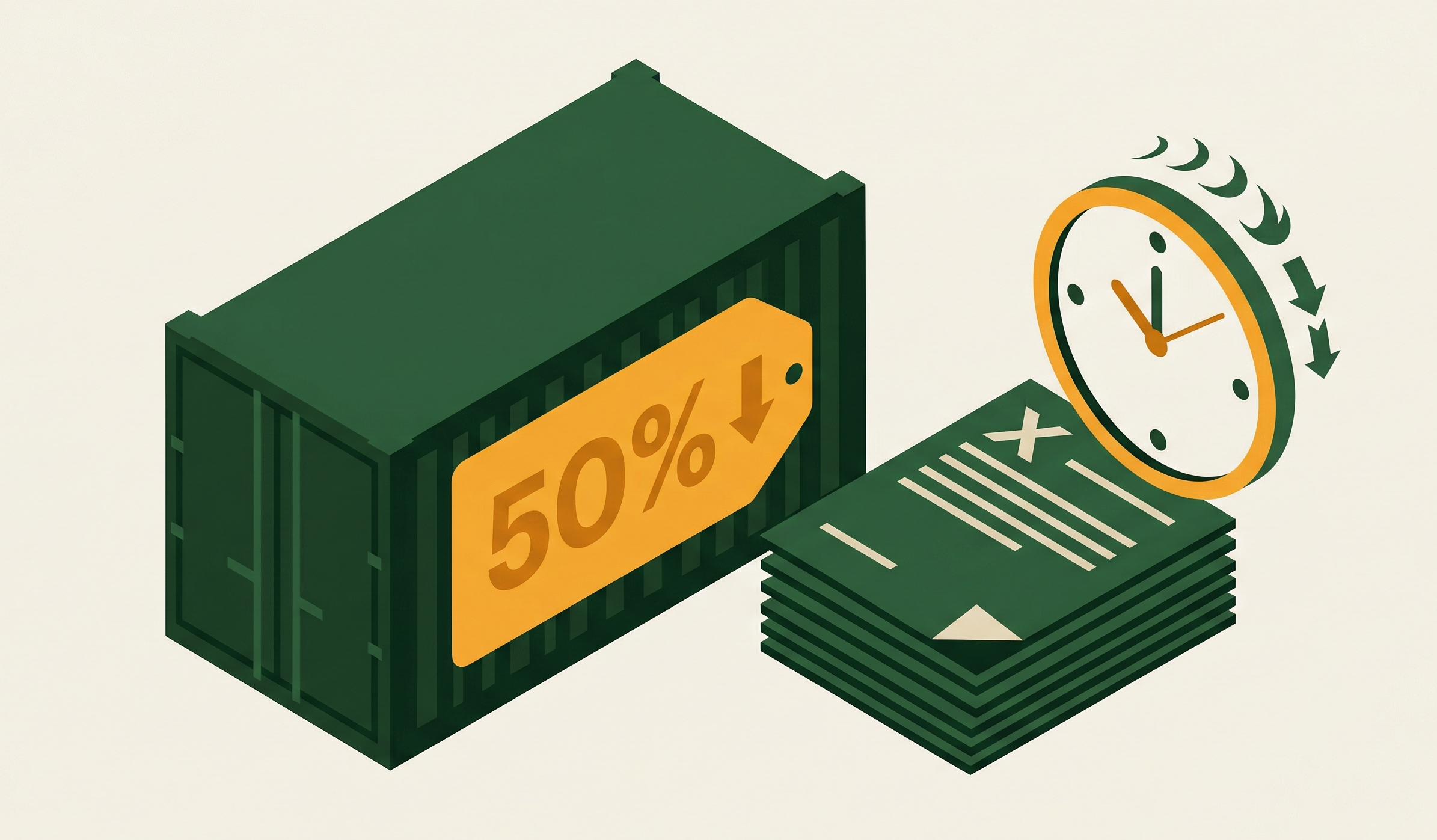
The Tariff Refund Trap: Why Importers Are Selling Their Claims for 50 Cents on the Dollar
In February 2026, the Supreme Court of the United States ruled that the IEEPA tariffs imposed by the executive branch in 2025 were illegal. For American importers who had spent the better part of a year paying a 10% global baseline duty on goods from dozens of countries, it was the outcome they'd fought for.
Then came the catch.
US Customs and Border Protection, the agency responsible for processing refunds, declared publicly that its systems were "not suited" for a task of this scale. The agency is currently building new functionality in the Automated Commercial Environment to handle an estimated 53 million individual entry refunds. Their timeline: months. Possibly years.
Across the industry, approximately $166 billion in duties are owed back to US businesses. The money is legally theirs. The court said so. But they cannot deposit a court order.
The paper billionaire problem
Trade coalition members have started calling it the paper billionaire problem: you have won on paper, but your actual bank account is bone dry. Meanwhile, you are still paying operating costs, supplier invoices, and the new Section 301 and Section 122 duties the administration has pivoted to in the wake of the IEEPA ruling.
For small and mid-sized importers — the companies without the revolving credit facilities and treasury departments of a Fortune 500 multinational — the double hit is severe. Their 2025 profit margins are sitting in a government escrow account they cannot access. Their 2026 cost base has, if anything, increased.
The hedge fund solution nobody should have to take
Into this gap has stepped a secondary market. Hedge funds and specialty finance firms are purchasing tariff refund rights from importers at 40–50 cents on the dollar. For an importer with $4.2 million in pending refunds, that means a choice: wait an unknown number of months for $4.2 million, or take $2.1 million today and be done with it.
Many have taken the deal. They needed the liquidity. The alternative — explaining to suppliers that payment will be delayed pending a government administrative process of indeterminate length — was worse.
But walking away from half your legal entitlement is a terrible outcome. It's a private tax on the companies least equipped to absorb it, extracted at precisely the moment they're most vulnerable.
What a hedge looks like instead
The alternative is to keep the claim and hedge the timing risk.
If you could purchase a financial instrument that pays out if your refund has not been processed by a specific date — say, September 30, 2026 — you would have the liquidity cushion you need to wait for the full refund rather than selling it at a discount.
The trigger is verifiable: either CBP has commenced processing refunds for your class of goods by that date, or it hasn't. The payout covers the operational cash shortfall while you wait. And you keep 100% of your legal claim.
That's not a theoretical instrument. That's a prediction market contract, traded on a CFTC-regulated exchange, with automatic settlement and no paperwork. The infrastructure exists. The use case is real. The only missing piece has been a platform designed to translate commercial tariff exposure into prediction market contracts — something Hérisson was built to do.
The broader lesson
The tariff refund situation is an unusually vivid example of a category of risk that exists across the economy: regulatory outcomes that are favorable but delayed, leaving businesses in a limbo that traditional finance has no good answer for.
The companies that figure out how to hedge timing risk — not just outcome risk — will have a material advantage over those that don't. In the current regulatory environment, where tariff policy is volatile and administrative capacity is strained, that advantage is more valuable than ever.