The $1 Trillion Insurance Gap: Why Modern Business Risk Has Outgrown the Policy
There is a version of business risk that every CFO, every event producer, every brand manager understands intuitively but that the insurance industry has never quite figured out how to cover.
It's not fire. It's not theft. It's not a hurricane. It's the cancelled show, the frozen refund, the rainy Saturday that doesn't trigger a force majeure clause but still wipes out 40% of your revenue. It's the celebrity who gets cancelled 72 hours before your product launch. It's the court ruling that says you're owed $4 million but gives you no timeline for actually receiving it.
These risks are real, they're quantifiable, and they're growing. And yet the insurance industry — an industry that has evolved over three centuries to price and transfer risk — largely has no answer for them.
Why the gap exists
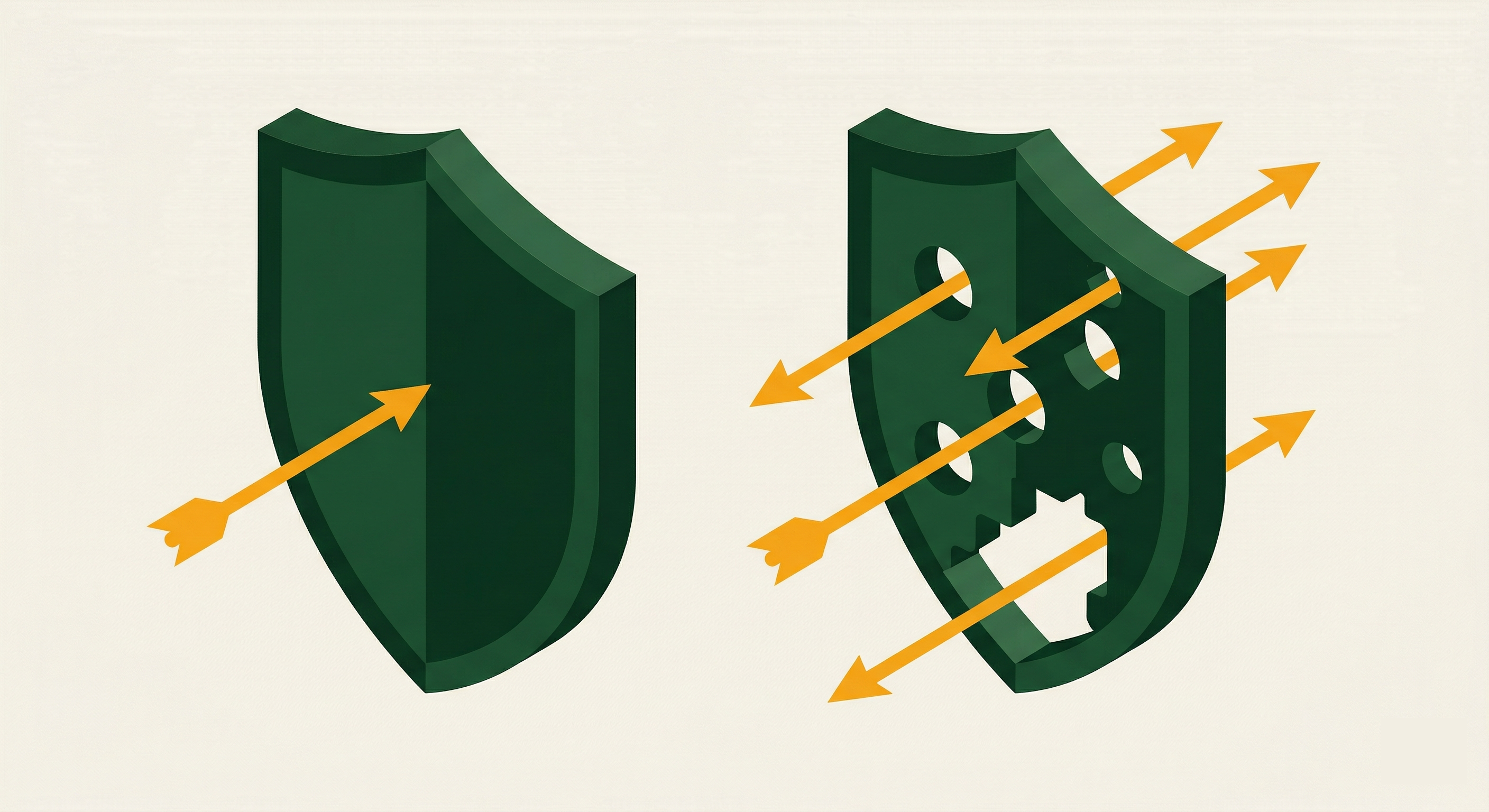
Traditional insurance was built around physical damage and legal liability. A fire destroys your warehouse: insurable. A flood damages your inventory: insurable. A customer slips and falls on your premises: insurable. The underlying logic is straightforward — an adjuster can survey the damage, assign a dollar value, and issue a payment.
The risks that define modern commerce don't work like that. They're reputational, regulatory, behavioral, or meteorological in ways that fall just short of the catastrophic thresholds that trigger coverage. A celebrity scandal doesn't burn anything down. A tariff ruling doesn't flood anyone's basement. A slightly rainy Saturday at a music festival is no one's idea of a natural disaster.
But the financial consequences can be just as severe. In some cases, more so — because they arrive without warning and without any mechanism for recovery.
Where parametric insurance has tried to help
Over the past decade, parametric insurance has made meaningful inroads in some of these grey zones. Rather than paying based on assessed damage, parametric products pay based on a measurable trigger — a rainfall threshold, a wind speed, a temperature reading. If the parameter is met, the policy pays out automatically. No adjuster. No claims process.
This is a genuine innovation. For agricultural businesses, coastal properties, and some travel operators, parametric products have started to fill gaps that traditional insurance couldn't touch.
But parametric insurance has its own limits. It is expensive and slow to set up, typically requiring custom underwriting from Lloyd's syndicates or specialty carriers. It is not available for most event-driven or reputational risks. And it has almost no penetration among small and mid-sized businesses, which lack the broker relationships and minimum premiums that the market requires.
What's changed
The emergence of CFTC-regulated prediction markets — and in particular the growth of Kalshi as a designated contract market — has created a new infrastructure that didn't exist five years ago. For the first time, it's possible to create a financial instrument tied to almost any verifiable future event, traded on a regulated exchange, with automatic settlement and full collateralization.
This isn't a niche product for retail speculators. The Federal Reserve has published research confirming that Kalshi's markets outperform traditional economic forecasting models. Bloomberg, the Wall Street Journal, and Fortune have all reported on the institutional capital flowing into prediction markets as legitimate financial infrastructure.
The missing piece has been a service layer — a business-focused platform that translates commercial risk into prediction market contracts, aggregates demand from multiple clients, and handles the execution and settlement on behalf of companies that have no interest in becoming prediction market traders themselves.
That's the gap Hérisson was built to fill. Not to replace insurance, but to cover what insurance has never been able to reach.
The trillion-dollar question isn't whether these risks are real. Every business operator already knows they are. The question is whether there's finally a financial instrument sophisticated enough to handle them.
There is.